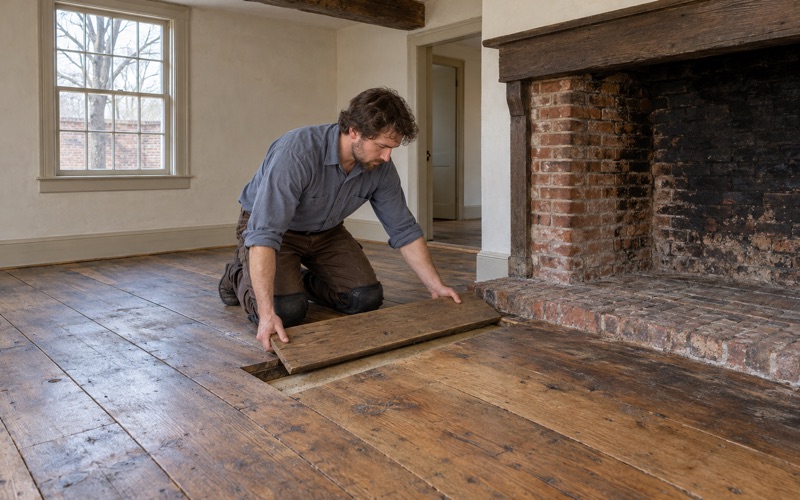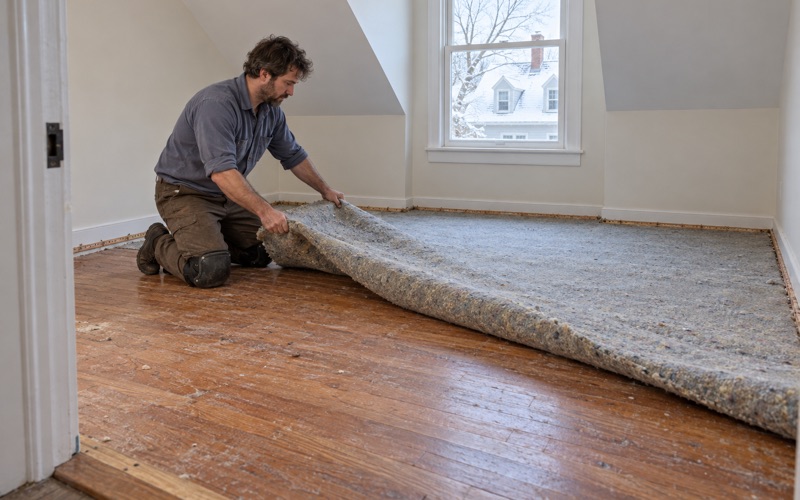
Medford Wood Flooring has handled wood-flooring in Woburn for more than 20 years, and a good share of the calls we take in this city begin with water rather than wear. A board that has cupped, a finish that has gone white and cloudy, or a hallway that suddenly lifts underfoot is usually the floor telling us that moisture got somewhere it should not be. Our job is to find out where it came from, get it out of the wood, and then decide what can be saved.
That order matters. Sanding a cupped floor before it has dried flattens the edges while they are still swollen, and once the boards shrink back the centers sit low, which is the crowning that ruins a refinish a season later. So we trace the water first, dry the room, and read the boards with a moisture meter before any board is replaced or any sander comes off the truck.
When the source is a burst pipe or an overflowing washer, the story is simple. When the source is the ground itself, as it often is here, the repair has to account for water that can come back, and that shapes everything from the flooring we recommend to how we document the damage for an adjuster.
Water That Arrives Outside the Mapped Flood Zones
What Woburn’s Own Hazard Plan Says
Many homeowners assume that if their street is not shaded on the federal flood map, a wet floor was simply bad luck. The City of Woburn’s 2021 Hazard Mitigation Plan update, prepared with the Metropolitan Area Planning Council, says otherwise. It lists areas that city staff identified as places where flooding is known to occur, and it states plainly that these areas do not necessarily coincide with the flood zones on the FIRMs, the Flood Insurance Rate Maps that FEMA publishes.
The same plan names the causes: inadequate drainage systems, high groundwater, or other local conditions that may not sit within a Special Flood Hazard Area. For a floor, those are three different problems. A storm drain that backs up delivers a sudden pulse of water, groundwater rises slowly and can linger, and a local low spot collects runoff in every heavy rain.
Streets the City Names
Table 8 of the plan gets specific. Flooding on Lake Terrace and Lake Circle affects both the roadway and homes, traced to inadequate drainage. Dragon Court has a low-lying area that affects homes and, in the plan’s words, no existing storm drain infrastructure. At Ward Street and Traverse Street a limited storm drain system impacts homes; a dry well was installed, and the plan records that flooding is reduced but not completely resolved.
The list continues. Lillian Street near the Kennedy School floods behind homes, and Winn Street near Hamilton Road has seen flooding of homes, reduced after culvert cleaning. Olympia Road and Henshaw Street take water from the Aberjona River, and New Boston Street from Halls Brook. We mention these not to say which house floods, which the plan does not establish, but because a homeowner on one of these streets should expect a damaged floor to have an outdoor cause, not only a plumbing one.
Repeat Losses in X Zones
The plan also counts Woburn’s repetitive flood-loss properties, which FEMA defines as NFIP-insured buildings with two or more paid losses of $1,000 or more within a 10-year period. The city has seven, with 17 losses from 1978 to 2020 totaling $634,454 in paid claims. Five of those seven properties, carrying 11 of the losses, are in X zones rather than the A-series zones most people picture when they think of flood risk.
For flooring, the lesson is repetition. A house that has taken water twice may well take it again, so when we repair a floor in that situation we plan for the next event as well as the last one. That affects what goes back down, how it is fastened, and which finish we recommend.
Looking for wood-flooring closer to Watertown? See Watertown Wood-Flooring.
Floors Beside Horn Pond Brook
When the Pond Crests
Horn Pond covers about 120 acres behind Horn Pond Dam, also called Scalley Dam, and drains a watershed of about 10 square miles. According to the hazard plan, when that capacity is exceeded the pond begins to crest at elevation 42.0, flooding the local roadway and impacting the residences and apartments that directly abut Horn Pond Brook. The city’s own restoration page calls flooding the most common and serious natural hazard in Woburn and notes that the roads and residences near the brook already experience it.
Brook water is not clean water. It carries silt and organic matter into the joints between boards and under the finish, so a floor that sat in it needs more than drying. We lift enough boards to see the subfloor, check the rosin paper or underlayment beneath, and decide whether the wood can be cleaned and kept or has to come out.
Older Houses, Older Floors
The housing near the brook, and across the city, skews old. Of Woburn’s 17,045 housing units, 3,181 were built in 1939 or earlier and another 3,206 in the 1950s. Those two groups are where we find red oak strip flooring held with cut nails or early flooring cleats over board subfloors, sometimes under linoleum or a carpet pad and tack strip that held moisture against the wood for days.
Old floors have usually been sanded before, sometimes more than once. When a wet board has to be replaced in a floor like that, we check the remaining thickness above the tongue and groove on the boards that stay, because a weave-in repair only works if the surrounding floor can take one more sanding.
Hidden Water Under the Floor
Water that sits under a floor does its damage out of sight. Subfloor boards that stayed wet can soften at the seams, and damp framing draws carpenter ants, which we sometimes find when we pull boards in a room that has flooded more than once. We look for that before new wood goes down, because a patch nailed to a soft subfloor will squeak and move within a year.
We also check the edges of the room, where water wicks up behind baseboards and into the ends of boards against the wall. Those perimeter boards are often the last to dry and the first to crown after a refinish, so they get their own readings rather than being judged by the middle of the floor.
Drying, Replacing and Refinishing Water-Damaged Boards
Drying and Reading the Wood
Wood takes on water through its end grain and its underside first, which is why a wet floor cups before the finish shows much. We open up the room, run air movement and dehumidification, and take moisture meter readings across the damaged area and in a dry room for comparison. The floor is ready to judge when the wet boards read close to the dry ones, not when the surface feels dry.
Buckling, where boards have pushed up off the subfloor, usually means the expansion gap at the walls was overwhelmed. Some buckled floors settle back once dried; others have sheared their fasteners and need to be relaid. Cupping often relaxes considerably as the wood gives up its moisture, which is exactly why we wait to see how much before quoting a sand.
Board Replacement and Weave-In Repairs
Boards that stay swollen, split, stained black or soft get cut out. We weave new boards into the existing floor, staggering the joints so the patch disappears instead of leaving a square outline, and we match species and width, whether that is red oak, white oak or maple. Water stains that go deep into oak often turn gray or black and will not sand out, so those boards are on the replacement list from the start.
Where the damage reaches a threshold, a reducer or the quarter round along a wall, we replace those pieces too. The same patching method handles the holes left where radiators and pipes came out, so a room that took water can lose its old scars in the same visit.
Refinishing the Room
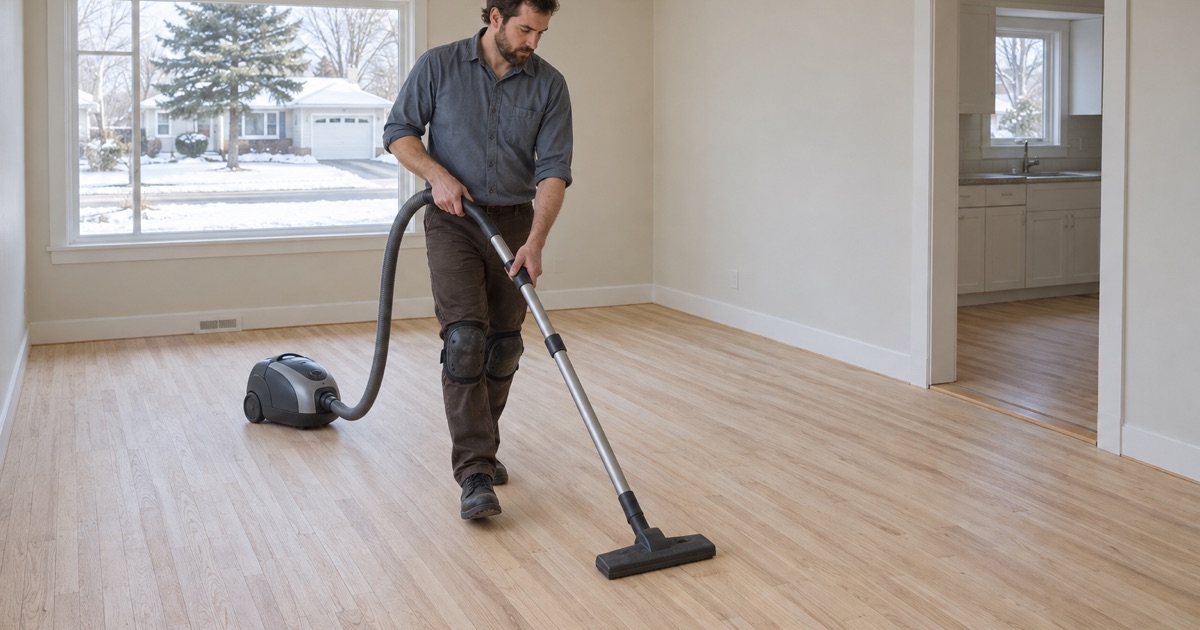
Once the repair is in, the whole room is sanded so new and old boards meet flat, working through a grit sequence with a drum sander in the field and an orbital sander at the edges, with dustless sanding and HEPA vacuum cleanup. Stain samples go down on the actual floor, in the room’s own light, because new boards and old ones take color differently. We then choose between waterborne polyurethane and oil-modified polyurethane from products that fit the Massachusetts VOC limits for wood coatings, which are stricter than the federal ones.
On older floors we also test for wax residue and cleaning-product buildup on the boards outside the damaged area before any finish goes down. A new coat over old wax peels, and a finish that fails next to the repair makes the whole job look like it failed. Stairs that took water on the way down to a lower level are quoted by the tread and riser, separate from the square-foot price of the floor.
Planning a Floor Repair in Woburn
Choosing Wood for a Lower Level That Stays Damp
If the water came from high groundwater or a street that floods in every heavy rain, putting solid hardwood back below grade is asking for the same call next year. For basement and lower-level rooms we match the floor to the moisture that is actually there, which usually means an engineered floor with a real engineered wear layer over a vapor retarder. A sump pump that works matters more than any flooring choice we can make.
Main-level floors are a different decision. Solid hardwood upstairs usually earns its keep, and a refinished original floor is often a better result than a new one. Seasonal winter gaps between boards are normal in heated houses and are not, by themselves, a sign of water damage.
Lead, Age and the Adjuster’s File
Woburn’s housing is old enough that lead matters on many jobs, and the city’s current Housing Production Plan notes that homes built before 1978 may require lead paint abatement. We check the build year and any painted surfaces, such as stair risers or baseboards, before sanding, because Massachusetts runs its own lead-safe renovation rules for homes of that age.
For water losses we photograph and measure each room, record the moisture readings, and list what was removed and why, so the adjuster sees the damage room by room. We do not tell anyone what a policy will pay; that is between the homeowner and the carrier. What we can do is make sure the file shows exactly what the water did to the floor.
Timing Around the Weather
Woburn sits in the National Weather Service forecast zone called Southeast Middlesex, and the heavy rains that fill the drains named in the hazard plan are the same ones that set our schedule. We book finish work when the house can be kept closed and dehumidified, so the new coats cure instead of trapping moisture.
On a floor that has flooded before, we lean toward a finish that can take a screen and recoat later. If the water comes back, a lighter repair and recoat may be enough, instead of another full sanding that takes more wood off boards that have already given up plenty.
- 20+ Years in Wood Flooring
- Stairs Priced by the Tread
- Moisture Readings Before Repairs