
Medford Wood Flooring works on hardwood stairs throughout Medford, MA, serving surrounding cities including Somerville, Malden, Winchester, Arlington and Everett. We refinish worn and painted stairs, rebuild carpeted stairs with new hardwood treads and risers, and match the stairs to the floors they connect.
Stairs are the part of a floor job that most estimates get wrong. They take far longer per square foot than any room, because almost every surface is sanded and finished by hand and every tread has edges, a nosing and corners. We quote stairs by the tread and riser rather than folding them into a square-foot price, so what you see on the estimate matches the work that goes into them.
After more than 20 years on wood floors and stairs, we also know that stairs in older houses hide things. Carpet may cover rough treads, and paint may cover good oak or may itself be the issue, since in a house built before 1978 it comes with its own rules.
Refinishing Existing Wood Stairs
Why Stairs Are Handwork
A drum sander cannot work on a stair, so each tread is sanded with smaller machines and by hand, along with the risers, the stair nosing and the skirt boards on either side. The inside corners, where the tread meets the riser, take the most time of all.
The finish is applied the same way, tread by tread. On a staircase that has to stay usable, we finish alternate steps first and come back for the rest, so the household can still get up and down.
Worn Treads and Stair Nosing
The front edge of each tread, the nosing, takes the most wear on any staircase, and it is often worn through to bare wood while the rest of the tread still has finish. Refinishing brings the whole tread back to an even color.
Where a nosing has split, rounded over badly or been damaged, we replace it or replace the whole tread. A sound, square nosing is also a safety issue on a stair used every day.
Stripping Painted Stairs
Many older houses have stairs that were painted decades ago, sometimes in several layers. In a house built before 1978, Massachusetts lead-safe renovation rules apply to disturbing that paint, and power sanding painted surfaces without HEPA-filtered exhaust is prohibited.
We check the build year and plan the removal, containment and cleanup accordingly. When the wood under the paint turns out to be poor, capping the stairs with new treads and risers is often faster and gives a better result than stripping.
Squeaky and Loose Stair Treads
A stair that creaks with every step usually has a tread that has worked loose from its stringers or risers, or wedges underneath that have dried out and slipped. The noise is more than an annoyance, because a loose tread can also split at the nosing over time.
Where the underside of the stair is open, we fix loose treads from below with glue blocks and new wedges. Where it is closed, we fasten from above and hide the fasteners in the finish, so the repair is invisible once the stair is refinished.
Converting Carpeted Stairs to Hardwood
What Is Under Stair Carpet
Pulling carpet off a staircase reveals tack strip, staples and carpet pad, and underneath that, treads that may or may not have been built to be seen. Some are finished hardwood worth refinishing; many are rough softwood with a square edge.
We check before quoting by pulling back a corner of the carpet. That tells us whether the job is a refinish or a conversion with new treads.
New Stair Treads and Risers
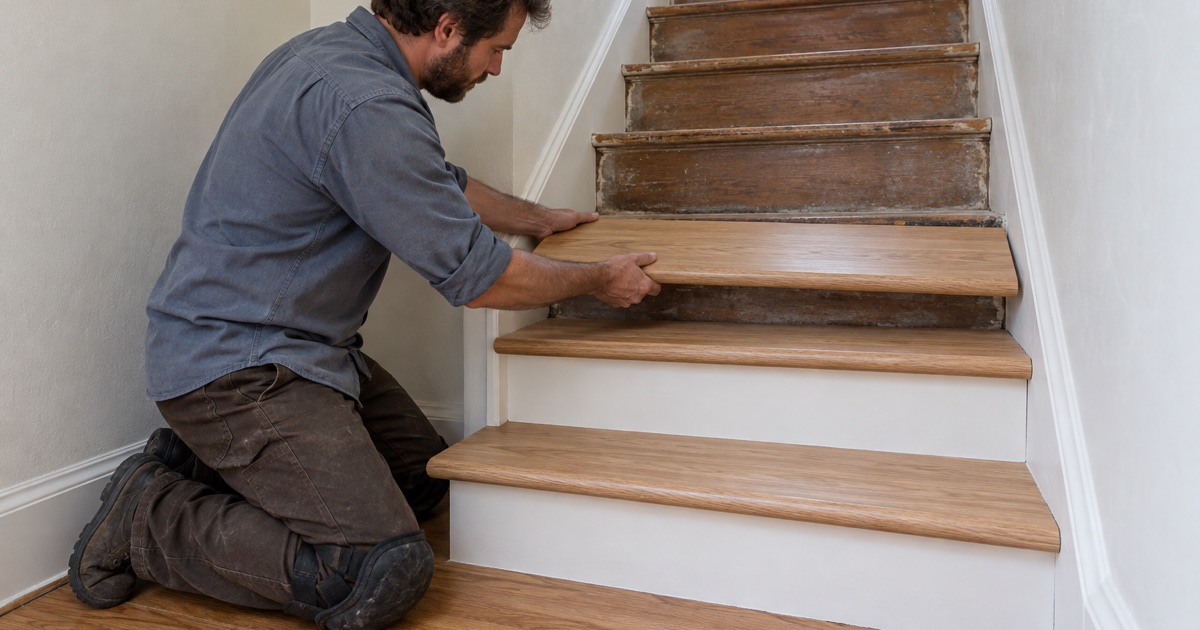
For a conversion, the old nosing is cut back and new hardwood stair treads are installed over the existing structure, with new risers, typically painted or stained, fitted between them. The new treads have a finished, rounded nosing sized to the stair.
The treads are glued and fastened so they are solid and silent underfoot. Getting the height of the first and last steps right matters, since a new tread changes the rise, and we plan for that at the top and bottom of the stair.
Matching Stairs to the Floors
New treads are usually oak, stained and finished to match the hallway and landing floors. When the floors are being refinished at the same time, the stairs are finished with the same product so the color and sheen match exactly.
Where a stair meets an engineered or prefinished floor, we use matching treads from the same manufacturer when they exist, or solid treads finished to match when they do not.
Landings, Balusters and Handrails
A staircase conversion usually includes the landing, which is floored like a small room and finished with the stairs so there is no visible break. Where a stair has balusters or an open side, the new treads have to be fitted around them with returned nosings on the exposed ends.
We protect balusters, newel posts and handrails during the work and can refinish them at the same time. Painted balusters in an older house are handled with the same lead-safe care as painted treads.
How We Price Hardwood Stairs
By the Tread and Riser
Our stair estimates list the number of treads and risers, whether each is being refinished, stripped or replaced, and any nosing, landing or skirt board work. That gives you a clear line-by-line price rather than a figure buried in the floor total.
It also makes it easy to compare options, such as refinishing the existing treads against installing new ones, because each is priced on the same basis. You can also decide to do the main stair now and a back stair later without the numbers changing.
What Changes the Price
Open stairs with exposed tread ends, winders that turn a corner, balusters and newel posts, and stairs with several layers of paint all take more time than a straight, closed staircase. A landing is priced as a small floor.
We walk the stair with you before quoting, so these details are counted from the start. That way they do not turn into additions once the work has begun.
- 20+ Years in Wood Flooring
- Stairs Priced by the Tread
- Moisture Readings Before Repairs