
Medford Wood Flooring does hardwood floor repair throughout Medford, MA, serving surrounding cities including Somerville, Malden, Winchester, Arlington and Everett, and much of that work is in houses where the floor is older than the people living on it. Over more than 20 years we have learned that a good repair is one nobody can find afterward.
That means matching the species, the cut and the board width, weaving new boards into the old ones instead of butting them into a square patch, and fixing the cause of the damage along with the damage itself. A board replaced over a still-leaking pipe or a still-active insect problem is a repair that will have to be done twice.
We repair floors on their own and as part of a larger refinish. When the whole room is going to be sanded anyway, repairs happen first so that new and old wood are sanded and finished together, which is the most reliable way to make a repaired area disappear.
Common Hardwood Floor Repairs
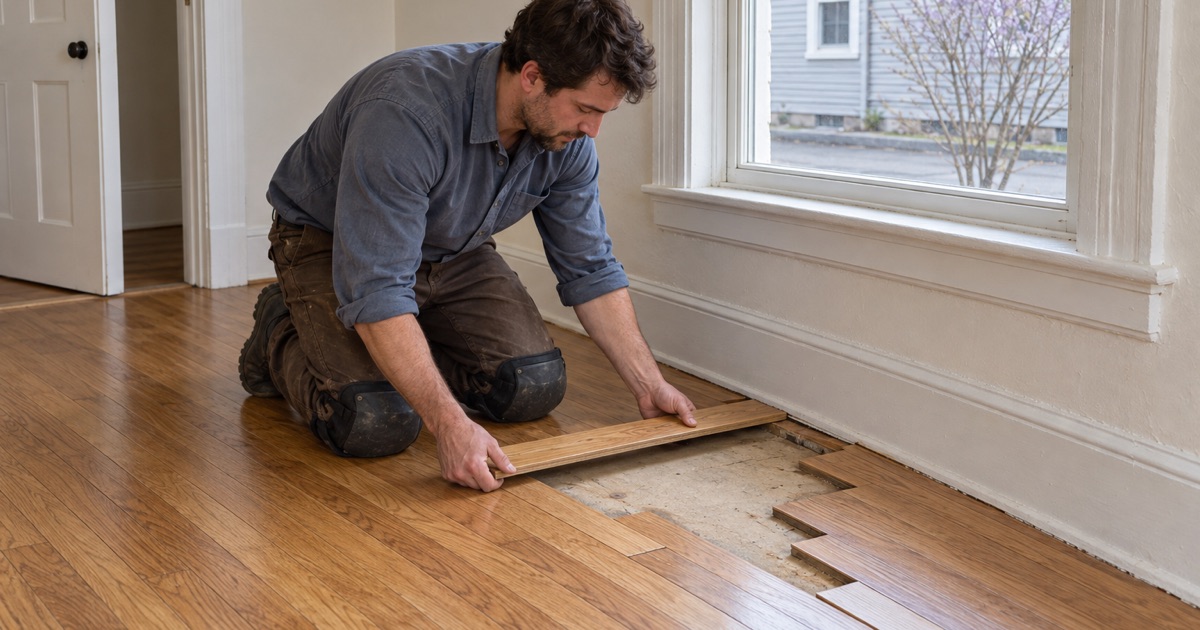
Board Replacement and Weave-In Repairs
A damaged board is cut out down its center, the pieces are pried free without harming the tongues and grooves of its neighbors, and a new board of matching species and width is fitted in. When several boards in a row need replacing, we stagger the new joints so they follow the pattern of the existing floor.
That weave-in approach is what separates a repair from a patch. A square of new boards laid side by side, with all the ends lined up, stands out forever; boards woven in at staggered lengths read as part of the original floor once they are finished.
Squeaks, Pops and Loose Boards
A floor squeaks when a board rubs against a loose nail or cleat, and it pops when a board flexes over a gap in the subfloor. Both get worse over time as the fasteners work loose.
Where the basement ceiling is open, we find the spots from below and shim or fasten them there, which leaves the floor surface untouched. Where it is closed, we fasten from above with small fasteners that are set, filled and finished so they vanish into the grain.
Gaps That Stay Open All Year
Board gapping that appears every winter and closes every summer is normal, and filling it causes more trouble than it solves. Gaps that stay open through the humid months are different, and often come from a floor that was installed too wet or has dried out permanently.
Narrow permanent gaps can be filled with a flexible filler during refinishing. Wide ones are best repaired with thin slivers of matching wood glued to one board edge, so the floor can still move without pushing the repair out.
Damage We Repair
Pet Urine Stains
Black stains from pet urine usually mean the liquid soaked through the finish into the wood fibers, where sanding cannot reach it. The subfloor underneath is often stained too, and it holds the odor long after the surface looks clean.
We cut out the affected boards, check the subfloor, seal or replace it as needed and weave in new wood. The repair is then sanded and finished with the surrounding floor so the color, sheen and texture match.
Beetle and Insect Damage
Small round exit holes surrounded by fine, flour-like powder usually point to powderpost beetles or old house borers, which feed inside the wood. Carpenter ants, by contrast, excavate galleries and leave coarser shavings, and they are often a sign of moisture nearby.
We recommend a pest professional to confirm whether an infestation is active and to treat it. Once that is done, we replace damaged boards and any weakened subfloor or sleepers, then refinish so the repair blends in.
Soft Subfloor at Toilets and Doors
A soft, spongy spot near a toilet, a tub or an exterior door almost always means the subfloor has rotted from a slow leak or from years of water tracked in on boots. The hardwood on top may look fine until it starts to flex.
We remove the boards over the soft area, cut the subfloor back to solid wood, replace it and reinstall new flooring woven into the old. The source of the water is identified first, so the repair is not undone by the same leak.
Repairs Typical of Older Houses
Radiator and Pipe Removal Patches
When radiators or steam pipes are removed, they leave rectangles of bare subfloor or holes where the pipes passed through the floor. Wood filler shrinks and cracks in holes that size, and a square inlay of new boards stands out.
We remove the boards around the opening and weave matching boards in at staggered lengths, so the patch disappears once the floor is sanded and finished with the rest of the room.
Face-Nailed Pine and Cut Nails
Old eastern white pine floors are often face-nailed with cut nails, sometimes over rosin paper or an older layer of boards. The wood is soft, and the nails can work up over time and catch on socks, rugs or a sander.
We reset raised nails, replace split or rotten pine boards with reclaimed or new pine of matching width, and keep the character of the old floor rather than replacing it with something uniform.
Matching Species, Width and Finish
A repair is only as good as its match. We identify the species and cut, measure the board width and thickness, and source replacement wood that matches as closely as possible, including reclaimed boards taken from a closet or another hidden area when that gives a better match than new stock.
The finish matters just as much as the wood. An old oil-based finish has ambered over the years, so a new board under a clear coat will look pale beside it; we either tone the repair to match or, better, refinish the whole room so every board carries the same finish.
Deciding Between Repair and Replacement
When Repair Makes Sense
Repair is the right choice when the damage is limited to part of a room, the remaining floor is sound and there is enough wood left above the tongue to sand. In those cases a repair plus a refinish costs far less than new flooring and keeps the original floor.
It also avoids the ripple effects of replacement: new thresholds, trimmed doors, a height change at the stairs and weeks of disruption. For most older homes with a handful of problem areas, repair is the practical answer.
When Replacement Is the Better Answer
Replacement makes more sense when damage covers most of the room, when the floor has been sanded too thin to take another sanding, or when water has damaged the subfloor across a large area. We explain which situation you are in before recommending either.
Sometimes the answer is in between: replacing one room while repairing and refinishing the rest of the house, or replacing a badly damaged section and weaving it into floor that is still good. We lay out those options with the cost of each so you can decide.
Repairs Before Selling or Refinishing
If you are preparing a house for sale or planning a full refinish, repairs should come first. Replacing stained boards, fixing squeaks and patching radiator holes before the sanding lets everything be finished together in one pass.
Doing it the other way round means sanding and finishing twice. A repair made after a refinish also rarely matches as well as one made before it, because the new boards miss the sanding that levels everything else.
- 20+ Years in Wood Flooring
- Stairs Priced by the Tread
- Moisture Readings Before Repairs