Medford Wood Flooring has handled wood flooring in Boston for more than 20 years, and the part of a Boston job that decides whether it goes smoothly is usually the calendar rather than the sander. Sanding, staining, finish coats and the drying time between them all have to fit into one plan, and here that plan starts with the hours the city sets for building work.
We lay the whole job out before the first board is touched: how many rooms, how many coats, how long each coat needs before anyone walks on it, and which days carry the loudest work. That schedule goes to the homeowner in writing, so the household, and anyone sharing a wall with it, knows what each day holds.
Most of what we do in the city is sanding and refinishing existing floors, patching old boards and repairing water damage, with new installation where an old floor is past saving. Every one of those jobs has a loud stage and a quiet stage, and sorting them correctly across a workweek is what this page is about.
When Floor Work Can Happen in Boston
What the Construction-Hours Rule Says
Boston keeps its own clock for building work. Section 16-26.4 of the City’s Municipal Code bars the erection, demolition, alteration or repair of any building except between 7:00 a.m. and 6:00 p.m. on weekdays, unless the work is in the interest of public safety or welfare and the Commissioner of Inspectional Services has issued a permit for it. The Boston Public Health Commission repeats the same window on its noise page: regular construction hours are 7:00 a.m. to 6:00 p.m. on weekdays.
The ordinance does not name floor sanding or refinishing, and we don’t pretend it settles every question about a floor job. What it does give us is a clear, published window that Boston residents recognize as the working day, and we build our schedules inside it rather than testing the edges. A plan that keeps the drum sander and edger running only during those hours is a plan nobody next door has reason to question.
After-Hours Work and Who Grants It
Work outside the weekday window runs through the Inspectional Services Department. Under 16-26.4 the Commissioner may issue a permit in the interest of public safety or welfare, and that permit can be renewed for one or more periods of no more than one week each. The Public Health Commission tells residents to check the after-hours permit database before they report building work outside regular hours.
For a floor, the useful question isn’t how to squeeze work into an evening. It is how to arrange the job so the evening never needs it. We plan sanding days with room to spare, so a slow room or an extra patch doesn’t push dust-making work toward 6:00 p.m. on a Friday. Complaints about construction during construction hours go to Inspectional Services too, which is one more reason we keep our days tidy and predictable.
Noise Limits Once the Workday Ends
The noise ordinance adds two more lines worth knowing. Section 16-26.1 treats noise over 50 dBa between 11:00 p.m. and 7:00 a.m., or over 70 dBa at any other hour, as unreasonable. Section 16-26.5 limits construction devices to 50 dBa at a residential lot line between 6:00 p.m. and 7:00 a.m.
Those numbers describe the evening and overnight quiet that Boston neighbors expect, and they shape how we end a day. Machines go off and are packed away before the window closes, and anything left for later is quiet work: reading a moisture meter, checking a coat for dust nibs, or setting out stain samples for the next morning. The house can settle down for the night without the sound of a job still underway.
Looking for wood-flooring closer to Reading? See Wood-Flooring Services in Reading.
Planning Sanding and Finish Coats Around a Boston Workweek
Early in the Week: Prep and the Grit Sequence
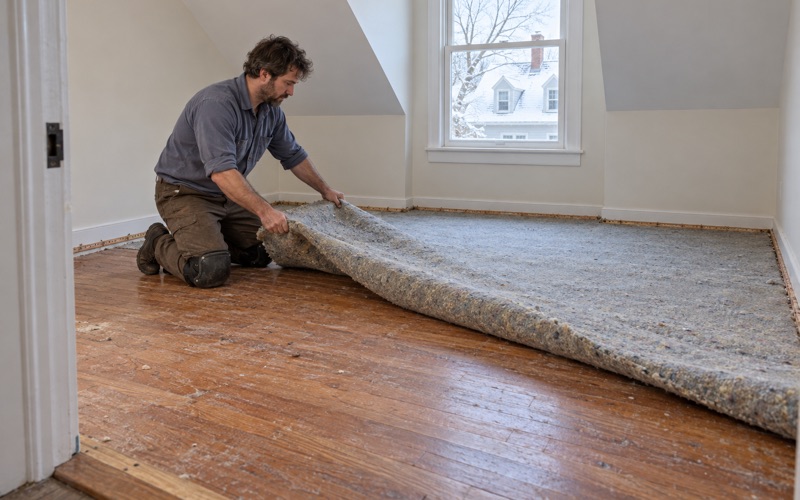
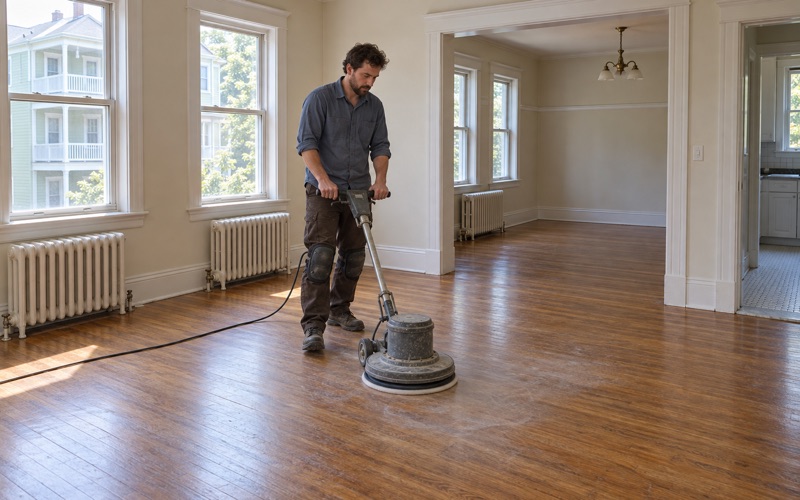
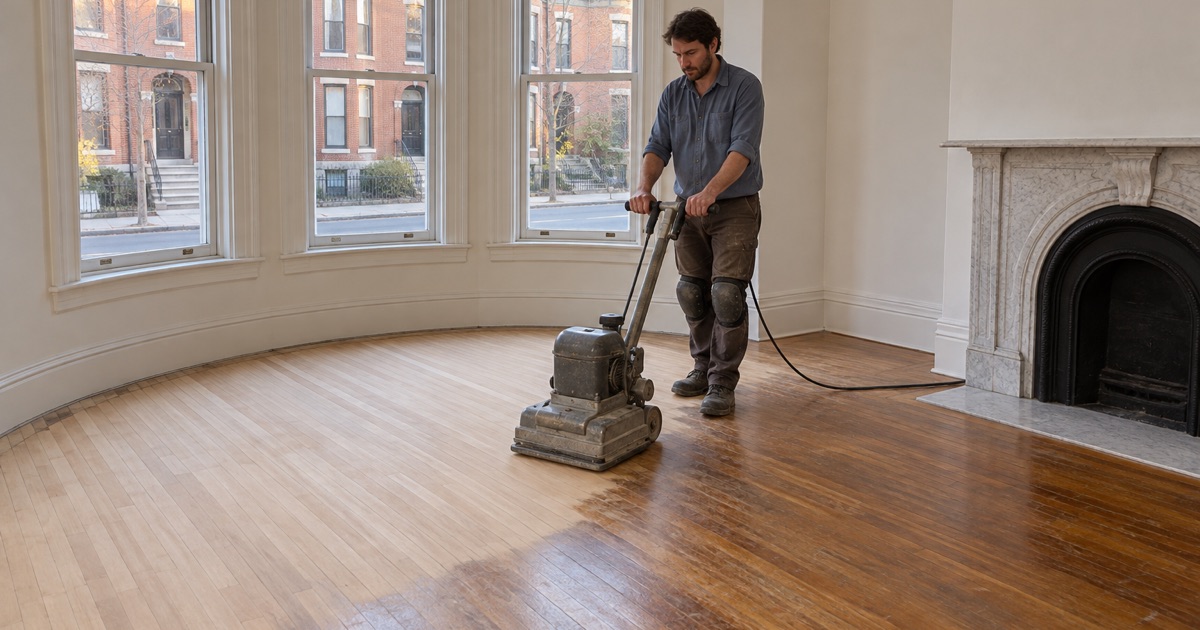
A typical refinish puts the loud work at the start of the week. Furniture comes out, quarter round is pulled where it needs to be, and we test for old wax residue or cleaning-product film that would stop a new finish from bonding. Then the drum sander runs through a full grit sequence, followed by the edger and an orbital sander to blend the perimeter and erase swirl marks.
We use dustless sanding rigs and a HEPA vacuum between passes, and we check board thickness before the first cut on older red oak strip flooring. A floor that has been sanded several times may have only one more pass in it, and knowing that on Monday morning changes what we promise for Friday. Front-loading the sanding also means a surprise, like a board that needs a weave-in repair, turns up while there are still working days left to fix it.
Stain Samples and Water Popping
Once the floor is bare, the week gets quieter. If the homeowner wants color, we lay stain samples on the actual floor, in the actual light of that room, and leave them long enough to be judged in daylight rather than under a work lamp. The same stain reads differently on white oak, maple and red oak, and a sample is the only honest way to see it.
For deeper, more even color we may water pop the floor, which raises the grain so it takes stain more uniformly. That step adds drying time, so it goes on the schedule as its own line instead of being folded into the sanding day. Stain then needs its own dry time before the first coat of finish goes over it.
Finish Coats and Drying Time
The finish decides how the back half of the week runs. Waterborne polyurethane generally allows more than one coat in a day and carries less odor, while oil-modified polyurethane needs longer between coats and longer before furniture returns. Hardwax oil is another option for a low-sheen look that can be spot-repaired later, and every product we choose meets the Massachusetts VOC limits for wood coatings, which are stricter than the federal ones.
Between coats the floor is screened or lightly abraded, which is far quieter than sanding and fits easily inside the day. We tell homeowners exactly when socks-only walking is fine, when rugs can go back and when the heavy pieces can return. A floor finished on a Thursday may look done on Friday but still be curing into the following week, and we plan the move-back around that, not around the weekend.
Sanding a Boston Floor With Neighbors Next Door
Shared Walls and Stacked Floors
In a city where so many households share a wall, a ceiling or a stairwell, the neighbor matters nearly as much as the client. Two-families, triple-deckers and condo buildings put another household within earshot of every sanding pass. We work owner-occupied two-families one floor at a time, so the family upstairs or downstairs keeps living in the house while its own rooms stay out of the job.
Before a sanding day we suggest the homeowner tell the people next door what to expect: which days are loud, roughly what hours, and when the quiet finish stages begin. A short note on a shared door does more for goodwill than any apology afterward. We keep to the times we gave, so the note stays true.
Dust, Old Paint and Pre-1978 Homes
Noise is only half of what a neighbor notices, and dust is the other half. Our sanding equipment connects to dust collection, and doorways are sealed with plastic before a room is opened up. In a shared hallway we protect the path from the entry to the work area so fine dust doesn’t track onto someone else’s stairs.
Boston’s housing is old: 145,114 of the city’s 310,625 homes counted by the American Community Survey were built in 1939 or earlier. We check the build year and any painted surfaces before sanding, because Massachusetts runs its own lead-safe renovation rules for homes built before 1978, and painted thresholds, stair risers and baseboard edges are where old paint tends to turn up. That check happens before the schedule is final, since it can change how a room is prepared.
Fitting the Job Into a Building’s Routine
Condo buildings and multi-family houses often have routines of their own, such as a shared elevator, a narrow back stair or a stretch of the morning when every resident is heading out. We ask about those early and fit deliveries, equipment moves and debris removal around them. Keeping the stairwell clear at 7:30 a.m. and 5:30 p.m. costs us nothing and spares the building a lot of irritation.
Where the unit below belongs to someone else, we pay attention to more than noise. Stain and finish go down with care near thresholds and floor vents, and we never leave a machine running unattended. If a neighbor raises a concern mid-job, the homeowner hears about it from us the same day, along with what we changed.
Scheduling a Floor Project Anywhere in Boston
Owner Households and Who Sets the Dates
The City’s Planning Department estimated Boston at 716,313 residents and 318,477 housing units in 2025, with 104,503 of the 294,982 occupied homes owner-occupied, about 35.4 percent. That share matters for scheduling. An owner living in the home picks the dates, lives with the dust barrier and walks on the floor the night the last coat goes down.
For owner households, we time the job around the family’s week: a room sanded while the kids are at school, a bedroom finished last so there is somewhere to sleep, and a kitchen doorway kept open as long as possible. In a condo, the owner’s plan also has to fit whatever the association expects, and we build that into the calendar rather than discovering it on day two.
What Older Boston Floors Usually Need
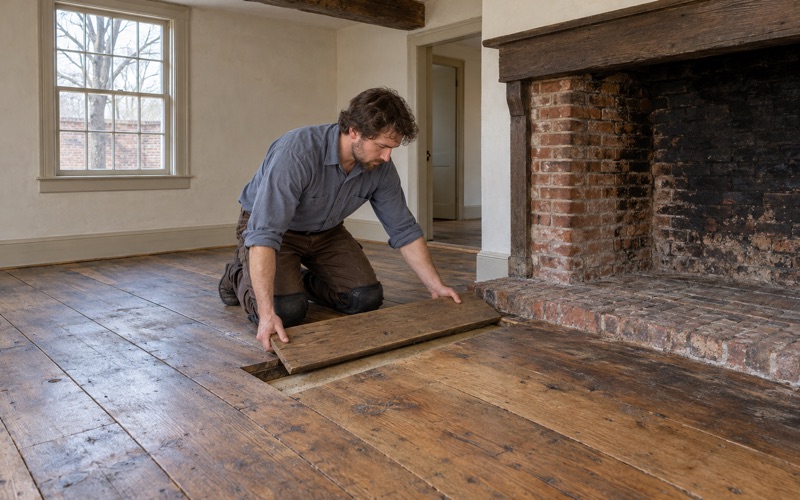
Many of the floors we open up are red oak strip or maple under decades of finish, with traffic lanes worn through at doorways, water stains near radiators and winter gaps that open as heating dries the air. Where radiators or pipes came out, we patch the holes with matching boards woven into the floor rather than filling them. Cupping, crowning or buckling after a leak gets traced to its source and read with a moisture meter before any board is replaced.
Stairs are quoted by the tread and riser, not tucked into a square-foot price, because each tread takes its own sanding and hand work. Lower-level rooms get flooring matched to the moisture that is actually there, which usually means engineered wood rather than solid hardwood below grade. Each of these adds days, and we say how many before the job is booked.
Getting a Boston Job on the Calendar
A good schedule starts with a walk-through. We measure the rooms, check board thickness, look for wax, pet urine stains and old repairs, and ask how the household uses the space. From that we write a day-by-day plan that puts sanding early, stain and finish later, and the move-back only when the coating is ready for it.
If a water-damaged floor is involved, we document the damage room by room for the adjuster before repairs start, which can shift the start date by a few days. Points we checked from East Boston and Charlestown to Dorchester and the South End all sit in the same National Weather Service forecast zone, MAZ015 ‘Suffolk’, so one forecast tells us whether a humid stretch is coming that could slow the drying. Tell us the rooms and the dates you have in mind, and we will show you how the week would run.
- 20+ Years in Wood Flooring
- Stairs Priced by the Tread
- Moisture Readings Before Repairs